From plant growth to controllable production.
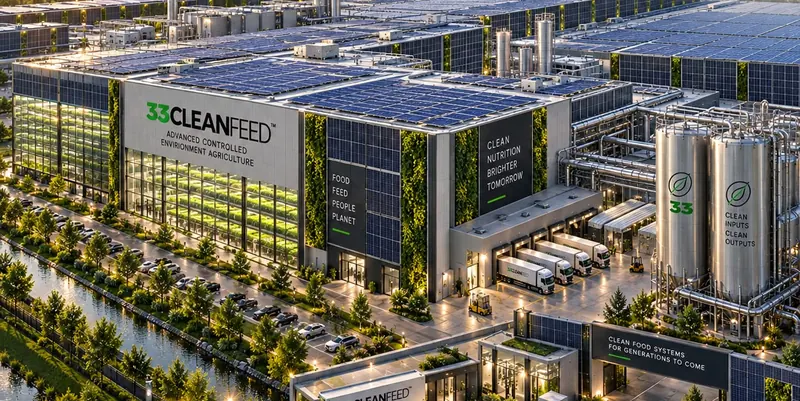
33CLEANFEED designs a modular production architecture for the next generation of feed and food. We connect plant biology, water, climate, biosecurity, automation, quality control and batch data — with saleable dry matter, product quality and real customer value as the yardstick.
One chain, measured per batch
- Input lot & quality M01–M02
- Crop- and phase-specific recipe M03–M04
- Water, air & energy metered M05–M06
- Harvest & stabilisation M07–M08
- QA release & batch data M09
- € per kg released saleable dry matter
Not kilos of wet biomass: released, saleable dry matter — with water, energy, labour and quality per batch.
More than growing plants under LEDs.
The potential value is in the integration: biological recipes, process conditions, water and climate control, contamination control, quality release, reproducible batch data and commercial measurability — designed together.
One production chain
We design inputs, biological process conditions, water, air, control, quality release and economics as one coherent production chain.
Precise about status
We make explicit what is design, internal R&D, an engineering target or a validated result.
Dry matter, not wet kilos
For feed, the lead KPI is euro per kilogram of released, saleable dry matter — not kilos of wet biomass.
Built with partners
We look for farmers, engineers, OEMs, laboratories, agronomists and knowledge partners to test and validate each part.
What we design and connect.
33CLEANFEED works out the architecture, the research questions and the validation plan — and brings in specialist partners to build, analyse and verify. Every domain shows where it stands today.
System architecture & modularity
Core Unit and modules M01–M09; interfaces between input, biology, utilities, controls, QA, stabilisation and dispatch.
Design Architecture worked out; build and integration are validated per project.
Crop & biological R&D
Hydroponic grass fodder, alfalfa/lucerne, sprouting and growth phases; recipes for light, water, nutrition and harvest timing.
Internal R&D Crop performance and optimal recipes still have to be validated.
Water & nutrients
Pre-treatment, reverse osmosis, remineralisation, dosing, water quality, possible reuse and site-dependent water from air (AWH).
Design Design options; water savings are measured per site, never assumed.
Air, climate & biosecurity
HVAC, dehumidification, HEPA filtration, zoning, airlocks, hygiene and monitoring.
Design Design principles that make risks controllable — not a sterility claim.
Sensors, control & automation
Instrumentation, data acquisition, PLC/edge architecture and alarms; model predictive control, AI and robotics as later layers.
Roadmap AI and robotics are planned layers, not installed systems.
QA, batch data & traceability
Measurement plan, sample IDs, batch records, hold/release decisions, Digital Batch Passport and corrective-action feedback.
Design Concept designed; laboratory methods and software still to be built and validated.
Stabilisation & product routes
Harvest, handling, drying or other stabilisation, and the split between feed and food specifications.
Design Process routes in design; food gets its own rules, QA and economics.
Unit economics & pilot design
Saleable dry matter, input/output mass balance, water, energy, labour, rejects, QA and cost per released output.
Design Method and model in place; cost figures follow from real batch data.
Partner & demonstrator development
Farm pilots, technical integration, laboratories, agronomy, universities, OEMs and consortium fit.
Open for partners No partnerships claimed until they are confirmed.
From input and water to harvest and quality release.
Co-develop a farm pilot
Explore with us how controlled feed production could fit your farm — with measurable quality, cost and practicality as the starting point.
Plug in your technology
A modular architecture for biological production — from crop recipe and water balance to QA, batch data and unit economics.
Validate it independently
An integrated demonstrator and validation agenda for plant biology, utilities, biosecurity, automation and product quality.
Several product and research routes, one architecture.
Grass fodder is the first focus. Alfalfa, plant compounds, mineral profiles and seed-independence are our own research lines; food crops, circular utilities and methane-intensity research follow as separately validated routes.
Ambitious direction, precise status.
We have worked out the system architecture and a development and validation plan. These are the parts that are designed, the parts that need partners and the milestones that have to deliver evidence first.
Worked out
- Modular system architecture M01–M09 with interfaces
- Development and validation plan with stage gates
- KPI and mass-balance method (released saleable dry matter)
- Evidence and claims discipline
In design / internal R&D
- Design of the instrumented pilot cell
- Crop recipes for grass fodder and alfalfa
- Mineral profile, DCAD and composition hypotheses
- Seed-independence research line
- Digital Batch Passport
Needs partners
- Engineering and build of the pilot cell
- Laboratory analyses and sampling methods
- Agronomy and animal nutrition
- A demonstration farm
- Independent validation
Must be proven first
- Reproducible released dry matter
- A closed mass balance
- Microbial and process control
- Water and energy per kg released output
- Customer value at a realistic price
Concrete collaboration routes.
We are looking for partners to co-develop, integrate and validate — not to sell a finished product. Choose the route that fits you.
| Partner | What we would work out together | |
|---|---|---|
| Farmers / demonstration sites | Explore a practical pilot: farm context, product need, reference feed, measurements, space, utilities, labour and cost. | Start → |
| Engineering companies / OEMs | Architecture and interface talks on water, air, racks, sensors, controls, robotics, stabilisation and integration. | Start → |
| Laboratories | A measurement plan for dry matter, composition, microbiology and crop-specific markers; methods, sampling and QA criteria. | Start → |
| Agronomists / nutritionists | Crop and phase protocols, feed comparisons, mineral/DCAD hypotheses, alfalfa and feed-outcome research. | Start → |
| Universities / knowledge institutes | Hypotheses, demonstrator set-up, trial design, data analysis, validation or research work packages. | Start → |
| Feed / food companies | Specifications, format, traceability, stabilisation, customer value and willingness to pay. | Start → |
| Consortium & project partners | Work-package fit, contribution, demonstrator, data/QA and validation milestones — no grant or participation claimed before award or contract. | Start → |
A first conversation in 30 minutes
- What is the application: feed, alfalfa, food, water/engineering or research?
- What is the problem today, and what is the baseline?
- Which outcome has to be measured, and how is it verified independently?
- Which input, installation, data, expertise or demonstration site can each party contribute?
- Which cost and quality limits decide whether we continue?
We don’t arrive with just an idea: we bring a structured system and validation approach. The next step is forming the right partner team around a well-defined pilot or validation question.
Standardised modules, one data layer.
The long-term direction is a network of standardised, modular production units connected by one data layer, where every unit adds comparable process data. We show it as a concept: every step towards it follows validated results. Roadmap
The people behind 33CLEANFEED.
A founder-led deep-tech initiative from Twente, The Netherlands: we develop the vision, architecture and research questions ourselves and work with specialists for building, analysis and validation.
Founder
Leads the vision, system architecture, product direction and research questions. Commercial background in B2B, e-commerce, trading and entrepreneurship since 2019.
Co-founder
Controlled feed and food production starts with a better-designed system.
Have a practical question, a product specification or a technology that fits? Tell us — we look together at whether a pilot, a validation or a technical collaboration makes sense.