Several product routes, one phased strategy.
Grass fodder is the first feed focus. Alfalfa, plant compounds and seed-independence are our own research lines. Food crops and circular utilities follow as separately validated routes — each with its own recipes, quality release and business case.
Seven routes, each in its right status.
Focus = current priority · Design = worked out on paper · Internal R&D = our own research line · To be validated = needs measured, independent data · Roadmap = later route · Concept visual = illustration, not an existing installation.
Hydroponic grass fodder
The first controlled feed route.
Focus To show: Released saleable dry matter, quality, microbiology, energy, water, labour, cost price and a rational use case.
Alfalfa / lucerne & nutrition R&D
A separate crop and recipe route: how germination stage, light, nutrients and process conditions shape composition.
Internal R&D To show: Crop response, minerals, protein and fibre, vitamins, enzyme activity where relevant, safety and customer value.
Seed-independence research
A long-term line towards less dependence on conventional seed and its input and contamination risks.
Internal R&D To show: Uniformity, losses, contamination, dry-matter recovery, cycle time, labour and cost against a seed baseline.
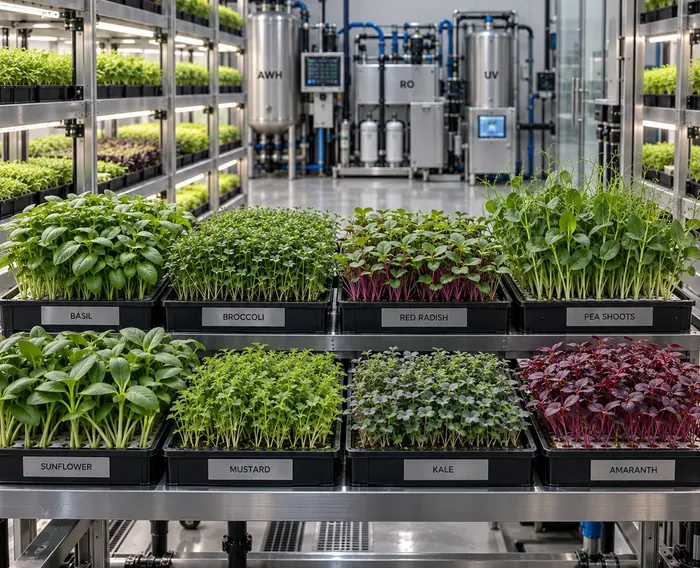
Microgreens & leafy greens
Possible high-value food routes within an extendable architecture.
Roadmap To show: Food safety, shelf life, microbiology, sensory quality, residues and margin.
Vegetables & fruit
Later extensions where technical and economic fit add up.
Roadmap To show: Variety-specific yield, quality, kWh, market price and shelf life.
Food / feed integration
Shared infrastructure, separate product routes: each with its own recipes, QA release and business case.
Roadmap To show: Separate hygiene zoning, specifications, regulation and economics per route.
Circular utilities
Water reuse, water from air, solar and residual streams — optional and site-dependent.
To be validated To show: Metered flows with a full system boundary; no automatic sustainability or cost claim.
Grass fodder and alfalfa: what we investigate.
How much dry matter stays saleable?
We compare fresh yield never in isolation, but together with dry-matter losses, energy, labour, rejects, quality and the dry matter that is actually released and sold. We plan to measure input seed and dry matter, harvest weight, dry-matter %, rejects, water, energy, labour, quality, microbiology and the resulting cost price.
Mineral profile & DCAD. Internal R&D A founder-led research line: the mineral profile as a recipe variable, tested against conventional forage and standard hydroponic fodder with comparable analysis protocols. Minerals and DCAD are ration-level concepts — no product parameter on its own guarantees animal health, milk yield or a ration result.
Does growth stage and light shift composition usefully?
Published research shows that germination can change elemental and biochemical composition, and that light exposure alters metabolic pathways in alfalfa sprouts. External evidence
That supports a stage-specific recipe, not a known optimum. Plant compounds — minerals, vitamins, phenolics and flavonoids, enzyme activity, nitrate or other crop-specific markers — are analysis parameters. “Optimising” does not mean maximising: safety, reproducibility, product goal and customer relevance set the target range, and no health effect is promised without evidence.
Food is not an automatic spin-off of feed.
Microgreens and leafy greens are possible high-value food routes; vegetables and fruit can follow once the technical and economic fit is there. Each needs its own food-safety plan, crop recipes, product specifications, shelf life, regulation, QA and business case — feed results are never extrapolated to food.
33CLEANFOOD is the working name for this possible food branch within the wider architecture. It is not a separate company or an available product line.
- Leafy greens: vitamins, minerals, nitrate, texture, microbial release, shelf life.
- Microgreens: plant compounds, sensory quality, shelf life, microbial release.
- Fruiting crops: Brix, acidity, texture, yield per kWh, shelf life, landed cost.
- Berries: sugar/acid balance, firmness, shelf life, price after logistics.
Is your organisation looking at one of these routes?
Tell us which product, specification or crop question you have in mind. We work out together what a validation track would look like.